Fundación Pachamama · Amazon partnership
Territorial rights and regenerative economies belong together.
Fundación Pachamama works with Indigenous peoples and nationalities to protect Amazonian territories, strengthen self-determination, advance human and Nature’s rights, and develop viable alternatives to extractive economic models.

01 · Partnership role
Infrastructure and enterprise begin with territorial legitimacy.
A technical project does not arrive before community authority.
Fundación Pachamama’s relationships with Indigenous organizations, communities, governments, producers, universities, and funders arise from a mandate much broader than its partnership with Building Carbon. Its work connects territorial protection, collective rights, organizational capacity, biodiversity, health, climate policy, and forest-based economies.
The shared work is narrower and specific: business-development and infrastructure pathways in the Ecuadorian Amazon, including bamboo construction and locally rooted bioeconomy initiatives. Pachamama contributes territorial relationships and program context; Building Carbon and RFI contribute project development, technical collaboration, and implementation capacity where invited.
02 · Institutional continuity
More than twenty-five years of Amazonian partnership.
Fundación Pachamama’s history begins with relationships between Achuar leaders and collaborators seeking alternatives to extractive development. Its institutional record combines territorial defense, rights-based advocacy, economic alternatives, organizational strengthening, and long-term alliance building.

That history includes intercultural education and health work, territorial mapping, ecotourism, strategic litigation, Indigenous governance, women’s leadership, climate justice, forest economies, and the Sacred Headwaters Initiative.
Its continuity also includes institutional defense. Fundación Pachamama was dissolved in 2013, continued working through Terra Mater, and recovered its legal status in 2017.
Relationships with Achuar communities establish the original institutional direction.
The organization supports the constitutional recognition of the Rights of Nature in Ecuador.
Work continues through institutional closure, legal action, and eventual restoration.
Programs operate across rights, territory, women’s leadership, forest economies, and climate finance.
03 · Institutional domains
Protection, rights, health, and economic alternatives.
Fundación Pachamama’s program areas are mutually dependent. Territorial protection without rights remains fragile; economic alternatives without governance can reproduce extraction; infrastructure without community authority can undermine the people it intends to serve.
Forests and territory
Territorial governance, conservation, climate policy, land protection, and Indigenous-led planning.

Forest economies
Bioenterprises, sustainable production, local value addition, market access, and alternatives to extractive income.

Human and Nature’s rights
Legal assistance, strategic litigation, public policy, leadership development, transparency, and environmental justice.

Ikiama Nukuri
Women’s collective leadership, maternal and reproductive health, protection from violence, and culturally grounded care.
people reached through the four-year Project Chakra record
communities across Napo, Pastaza, and Morona Santiago
bioenterprises selected from 123 applications
of selected bioenterprises reported as led by women
These figures come from Fundación Pachamama’s published closing record for Project Chakra and its Pacha Emprende incubation component. They are not Building Carbon program results.
04 · Economías del Bosque
Economic activity structured around people, territory, and biodiversity.
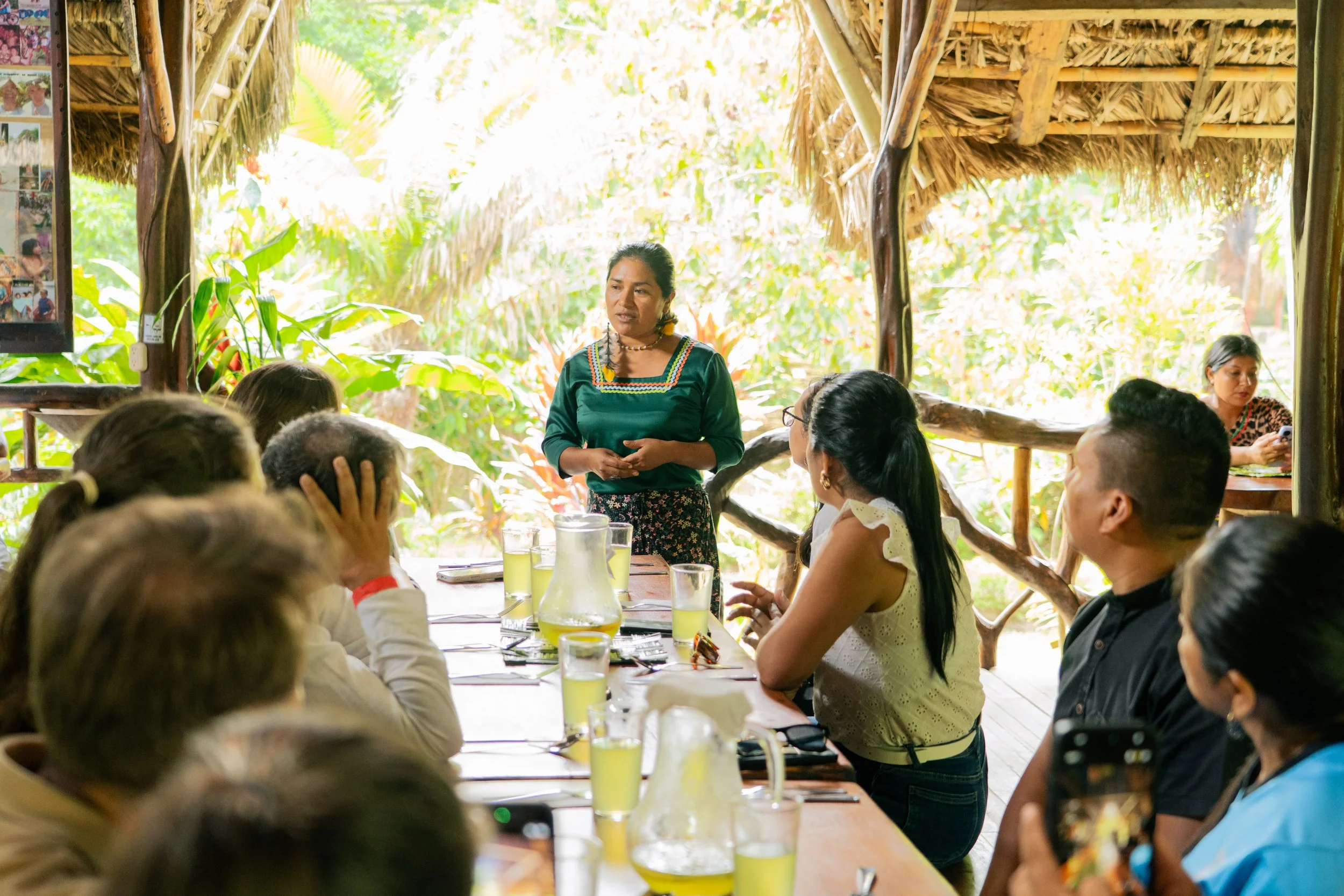
Fundación Pachamama accompanies Amazonian bioenterprises that use biodiversity sustainably while developing economically viable alternatives for community wellbeing. The work encompasses organizational capacity, production, value addition, certification, commercialization, and relationships with markets and public institutions.
Project Chakra connected conservation, community governance, agrobiodiversity, innovation, and value chains across products including vanilla, morete, cinnamon, plantain, cassava, macambo, wild cacao, and natural cosmetics. Pacha Emprende continues the commercial-development pathway for enterprises with established products.
05 · Shared infrastructure work
Bamboo construction enters an Amazonian project network.
In 2025, Fundación Pachamama publicly documented a social-interest bamboo housing project in Pastaza developed with Regeneration Field Institute and the Prefecture of Pastaza. The project connected modular construction with local public infrastructure and forest-economy objectives.
The Building Carbon relationship extends from that intersection: project development and implementation pathways for bamboo infrastructure and socio-environmental initiatives. Future work must remain grounded in community decisions, local government responsibilities, verified building performance, and explicit institutional agreements.
Territorial relationships, program context, community and institutional coordination, and Amazonian bioeconomy strategy.
Bamboo design, applied education, construction practice, technical training, and project development.
Financing pathways, implementation management, documentation, and development of scalable public-benefit projects.
Project authority, participant priorities, land and permitting conditions, local labor, oversight, and long-term use.
06 · Collaboration boundary
The partnership does not transfer institutional ownership.
Fundación Pachamama’s history, Indigenous relationships, rights work, forest programs, health initiatives, partners, and public record belong to Fundación Pachamama. Building Carbon presents only the intersection relevant to shared infrastructure and socio-environmental development.
Building Carbon and RFI do not speak for Indigenous peoples, direct Pachamama’s programs, or treat Amazonian territories as a deployment surface. Collaboration requires invitation, defined roles, consent, local governance, technical accountability, and accurate attribution of each institution’s work.
Read Fundación Pachamama’s complete mandate07 · Institutional resources
Continue through the primary record.
Fundación Pachamama maintains the authoritative record of its history, programs, partners, publications, and current Amazonian work. Building Carbon’s Bioeconomy and Bamboo pages document the narrower fields in which shared development may occur.