Virginia Tech BioDesign Research Group · Biomaterials and smart construction
Biological materials developed as construction systems.
The BioDesign Research Group integrates biomaterials, biofabrication, natural science, computational design, and advanced fabrication to develop lower-carbon approaches for the built environment.

01 · Institutional role
Convert material variability into design intelligence.
Bamboo is not standardized stock.
Every culm varies in diameter, wall thickness, curvature, nodes, taper, moisture, and mechanical behavior. The BioDesign Research Group examines how sensing, computation, fabrication, material testing, and full-scale prototyping can work with that variation rather than eliminate it through energy-intensive processing.
Within the Building Carbon network, the group contributes research leadership and design-development capacity. Los Arboleros provides a permanent tropical field site; RFI organizes applied education and building practice; and Building Carbon connects technical development to financing, implementation, and regional supply-chain questions.
02 · Research method
From irregular culm to repeatable assembly.
The research does not begin by forcing bamboo to imitate a conventional board or beam. It begins with the biological geometry of the material and develops tools, connections, assemblies, and tests around its actual behavior.
- 01
Characterize the material.
Document geometry, sectional properties, species behavior, strength, defects, moisture, and the limits introduced by each processing decision.
- 02
Model the variation.
Use scanning, computational design, and parametric methods to match available culms with parts and assembly requirements.
- 03
Develop fabrication.
Test selective facing, milling, tooling, connections, composite strategies, panelization, and workflows that preserve useful material.
- 04
Build and revise.
Move from specimens into full-scale assemblies, document performance and failure, and return the findings to the next design cycle.
03 · Public research record
A sequence of tested questions.
The collaboration rests on an existing research record—not a single speculative rendering. Publications, full-scale installations, field construction, and current partner research represent successive stages of development.
2019 · Material performance
Faced bamboo is mechanically examined.
Published work evaluates how selective facing affects structural performance and where flat interfaces may enable more consistent joined assemblies.
2021 · Full-scale fabrication
Mass Bamboo enters the research space.
A full-scale test in the Virginia Tech Bamboo Research Space examines digital fabrication, semi-solid elements, surface treatment, and assembly behavior.
2023 · Ecuador field build
Research meets tropical field conditions.
Virginia Tech students and faculty work with RFI, a local architect, and a local carpenter to construct an experimental cabin at Los Arboleros.
2024–2025 · Panel research
Physical and mechanical testing expands.
A public Ikiam research record documents collaboration with Virginia Tech, RFI, and INBAR on locally sourced bamboo panels and safe, scalable construction applications.
04 · MassBu
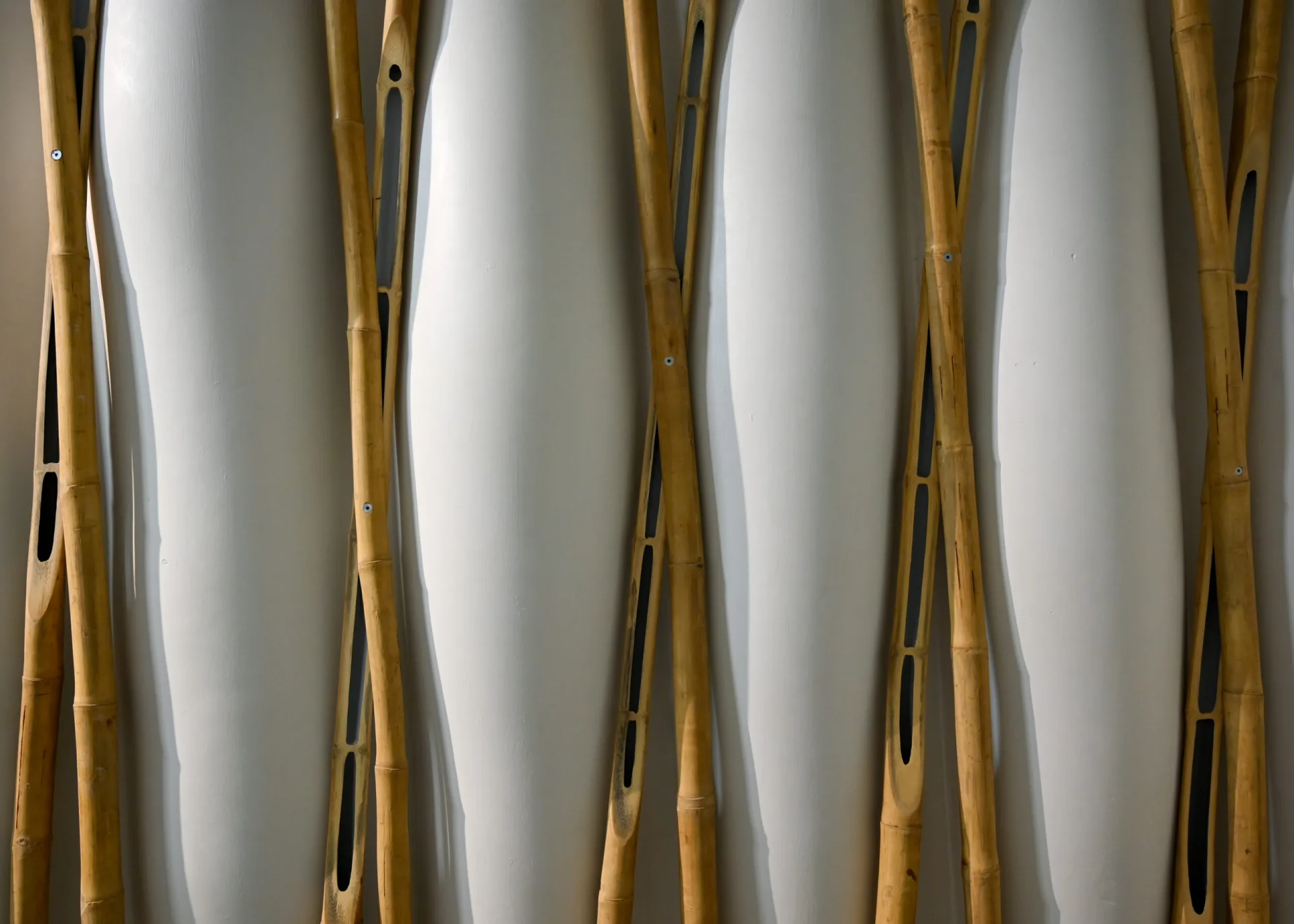
Lightly modified culms assembled into larger components.
MassBu is a research proposition for using lightly modified bamboo culms in laminated panels, beams, and related building components. The objective is to retain more of each culm’s structural section while creating surfaces and assemblies that can be fabricated, joined, tested, and installed more consistently.
How much of the original culm can remain within a dependable structural component?
How can irregular pieces be analyzed and placed without forcing complete standardization?
Which connections, faces, laminations, and panel configurations produce reliable load paths?
Which tooling and quality controls can operate within a regional bamboo supply chain?
Current status: MassBu remains under research, prototyping, and testing. No claim of code approval, commercial validation, or unrestricted structural use should precede the supporting technical evidence.

05 · Ecuador field collaboration
The laboratory does not replace the building site.
The 2023 experimental cabin at Los Arboleros placed university research inside a working farm, tropical climate, local material stream, and collaborative construction process. Students and researchers worked alongside RFI, a local architect, and a local carpenter.
The project exposed questions that isolated specimens cannot resolve: transportation, preservation, moisture, tool access, dimensional variation, sequencing, safety, local craft knowledge, repair, and the communication required to move between digital files and physical construction.
This field relationship provides a practical development environment for MassBu and related research while keeping experimental results distinct from validated building performance.
06 · Collaboration architecture
Each institution holds a different part of the work.
A research partnership is strongest when authorship, field responsibility, implementation, and testing remain explicit. These institutions collaborate without becoming interchangeable.
Research direction, computational design, fabrication methods, full-scale prototypes, scholarship, and student participation.
Applied education, construction practice, field coordination, and translation between research questions and local building conditions.
Permanent field site, bamboo resources, workshops, local operating knowledge, and continuity beyond a university visit.
Project development, financing pathways, implementation partnerships, and the production and supply-chain questions required for broader application.
07 · Research and resources
Follow the technical record.
Primary project pages, publications, and institutional reporting provide the appropriate record for research claims. Building Carbon’s Bamboo page connects that work to regional cultivation, fabrication, implementation, and bioeconomy development.